Every custom cosmetic tube arrives at the same fork: how do you get artwork onto a flexible, often curved, sometimes oily plastic or laminate surface so it survives filling, shipping, and a bathroom shelf? The tube itself is only half the decision. The decoration method sets your color range, your minimum order, your per-unit cost, and how the finished tube ages. Five methods cover almost every project, and they trade off against each other in predictable ways. This is a side-by-side look at what each one does well and where it falls down.
Before the methods, one piece of physics matters. A squeeze tube flexes every time it is used, so any decoration has to bend without cracking or flaking. That single fact explains why some approaches that look great on a rigid bottle behave differently on a tube, and why substrate, ink cure, and any protective overcoat matter as much as the printing technique.
The tube material shapes the decision too. Plastic-barrier and all-plastic tubes take direct printing and labels well and are the most common. Laminate tubes with a metallic layer can show through thin ink, so they often need a white base or benefit from a label. Aluminum tubes behave differently again and usually rely on offset and coatings. Diameters run in a standard ladder from roughly 19 mm up to 50 mm, and the smaller the diameter, the tighter the curve, which shrinks the flat-looking print area and makes fine detail and edge-to-edge wraps harder. Confirm the decoration method against the exact tube before committing art.
Silk screen printing
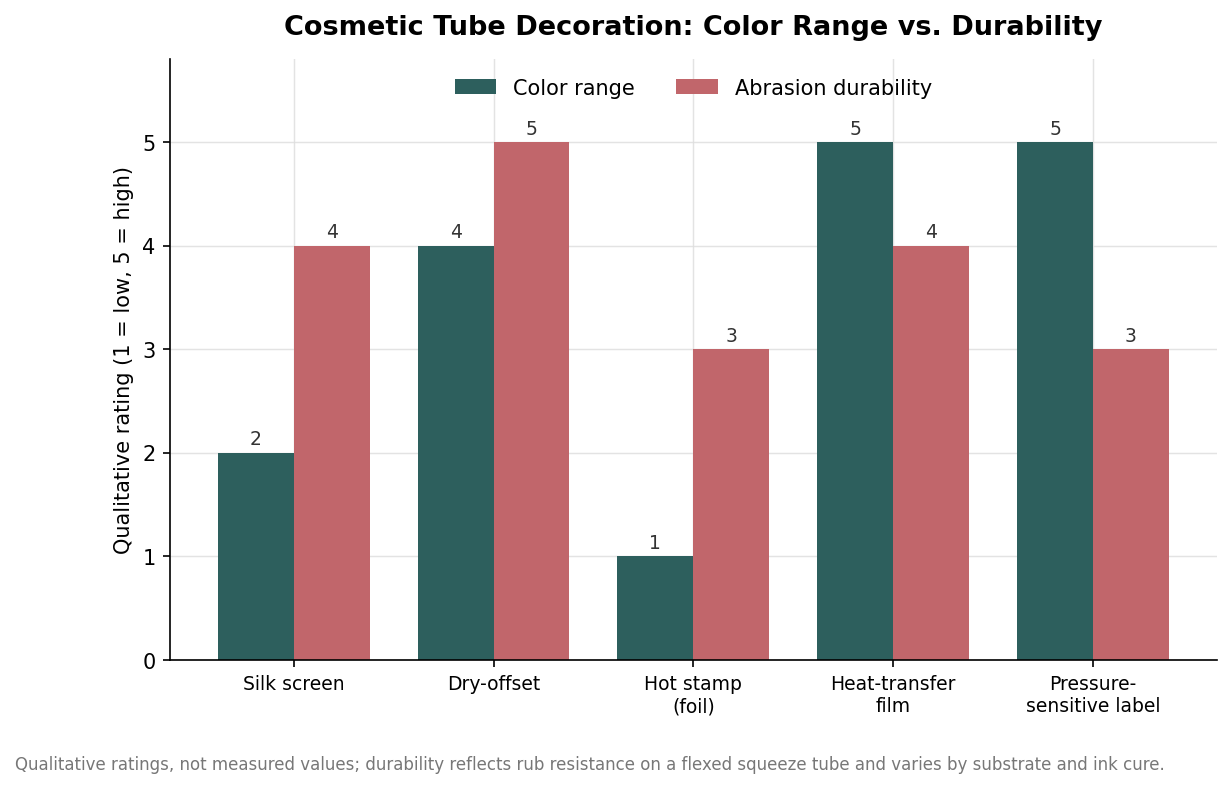
Silk screening pushes ink through a fine mesh, one screen per color, laying down a thick, opaque, tactile layer. It is the workhorse for tubes carrying a logo and a few lines of type in one or two solid spot colors. The ink sits durably on the surface and holds up to flexing when properly cured, and spot-color matching is reliable, which brands care about. The limits are color count and imagery: each additional color is another screen, another pass, and more cost, and screen printing cannot reproduce photographs or smooth gradients. On a colored or metallic tube you often need a white underprint first so the ink reads true, which adds a pass. Minimums start from just 12 tubes on stock formats.
Dry-offset (letterset) printing
Dry-offset transfers multiple colors from plates onto a blanket and then onto the tube in a single rotation, so it prints up to six or eight colors in one pass at high speed. That makes it the volume method: once the plates are made, per-unit cost is low, which is why large personal-care runs use it. The catch is the tooling. Plate setup is the highest of the direct-print methods, so dry-offset only makes economic sense at scale, typically many thousands of units. Like screen printing it works in line art and solids rather than true photographic imagery, though skilled separations can suggest more.
Hot stamping and foil
Hot stamping presses a heated die against a foil so a thin metallic or pigment layer bonds to the tube. It is an accent method, not a full-coverage one: think a gold logo, a silver band, or a holographic highlight. Each die lays one foil, with no gradients and no photographic detail, and the die is a real tooling cost. Used sparingly it signals premium better than any ink can, which is why prestige skincare leans on it. Used as the whole design it is expensive and limited. On a flexing tube, keep foiled areas small and away from the heaviest squeeze zones so the foil does not craze.
Heat-transfer film and pressure-sensitive labels
The two labeling routes are where full color lives. Heat-transfer printing pre-prints a design onto a carrier film and heat-bonds it to the tube, producing a photographic, near-seamless wrap that resists rubbing and water well once applied. It is the choice when the brand needs gradients, images, or a wrap-around design that direct printing cannot match, and the per-unit cost reflects that. Pressure-sensitive labels are printed adhesive labels applied to the tube. They give full color at the lowest setup cost, turn around quickly, and make short runs and multiple SKUs practical because you only change a label, not a set of plates. Their weakness is the edge: on an oily, flexing, or textured tube a label can lift or curl over time, so material choice and a tight application spec matter, and a wrap that meets or laminates helps.
Choosing by artwork, volume, and budget
Work from three questions. First, what does the artwork demand? One or two solid colors point to silk screen; six-plus colors at scale point to dry-offset; a metallic accent points to hot stamp; photographs, gradients, or wraps point to heat-transfer or labels. Second, what is the volume? Direct-print methods reward large runs by amortizing setup, while labels win at low quantities and for frequent SKU changes. Third, where is the budget: tooling or per-unit? Offset and hot stamp front-load cost into tooling, labels shift it to per-unit, and silk screen sits in between.
Many real projects mix methods. A common combination is dry-offset for the main body color and copy plus hot-stamped foil for a logo accent, giving both efficiency and a premium cue. Whatever the mix, ask for a physical proof on the actual tube substrate rather than approving on a flat mockup, and confirm any overcoat or lamination, because how the decoration behaves on a squeezed, filled tube is the only test that counts. Treat every cost figure here as indicative and directional; real quotes swing with tube material, color count, run size, and finishing.