A cosmetic tube looks like a simple package, but it is really three decisions stacked together: how big it is, what it is made of, and how the product comes out. Get the combination right and the tube dispenses cleanly, protects the formula to the end of its shelf life, and feels appropriate to the price on the box. Get it wrong and you end up with a serum in a body-lotion tube, or a sensitive oil in a material that lets it degrade. This guide walks through choosing a tube by the product going inside it.
Start with fill volume, and let it pick the diameter
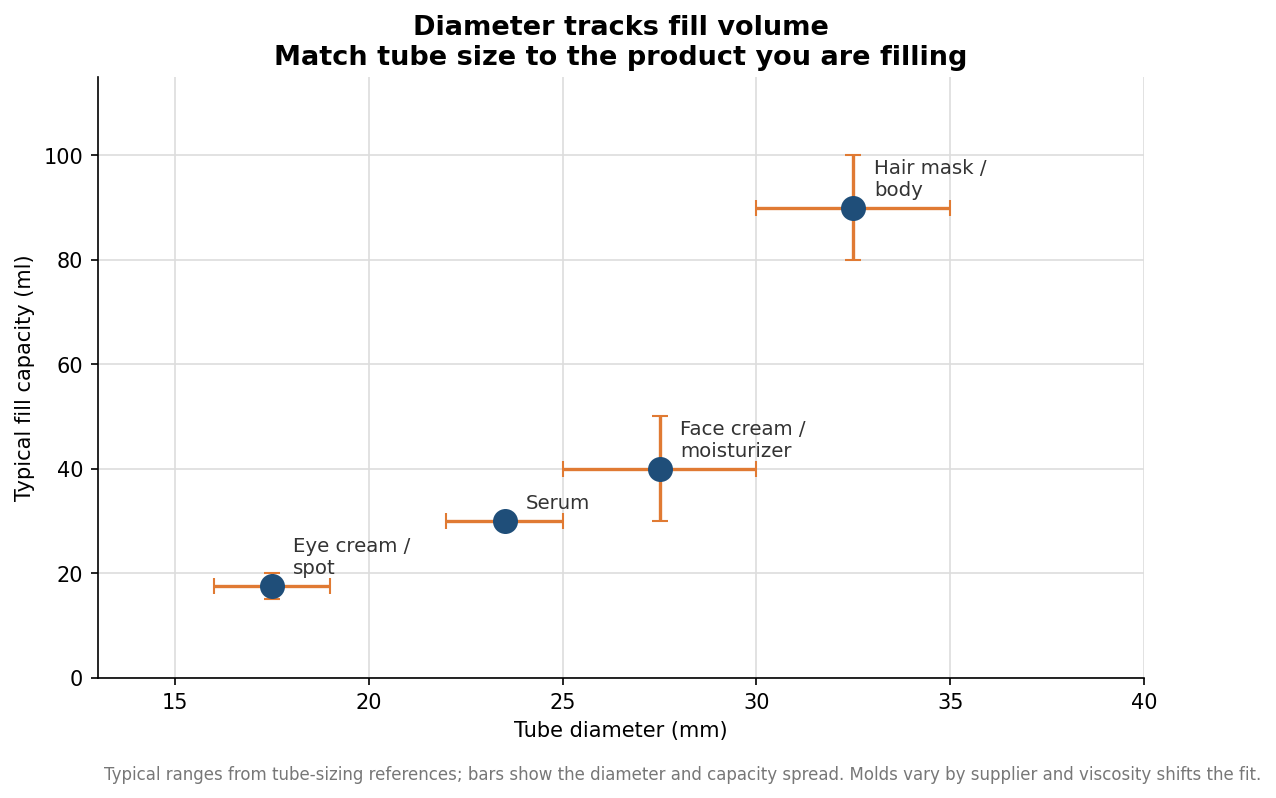
Diameter and capacity move together, so the practical starting point is the fill volume your formula needs. Tube-sizing references line up fairly consistently: an eye cream or spot treatment at 15 to 20 ml suits a slim 16 to 19 mm tube, a serum around 30 ml fits a 22 to 25 mm diameter, a face cream or moisturizer at 30 to 50 ml lands at 25 to 30 mm, and a hair mask or body product in the 80 to 100 ml range needs a 30 to 35 mm tube. Length scales with the same logic, running from roughly 70 mm on the smallest tubes to 160 mm on the largest.
One caution the sizing charts repeat: molds vary by supplier, and viscosity changes the fit. A thick balm and a runny lotion of the same volume can want different diameters and outlet sizes, so treat these pairings as a starting point and test with your actual formula before committing to tooling. Leaving a little headroom also matters, because tubes are not filled to the absolute brim.
Choose the material for the formula, not the shelf
Material is where most of the real engineering lives, and the honest way to frame it is a trade between barrier protection and recyclability. Extruded PE tubes, in LDPE, MDPE, or HDPE, are the flexible, cost-effective default with good resistance to oils and typical skincare bases and good recycling potential as a largely single-material structure. They squeeze well and print well, which is why they cover so many creams, lotions, gels, and cleansers.
When the formula needs more protection, laminates step in. ABL, aluminum barrier laminate, offers excellent defense against oxygen, moisture, and light, which is why it shows up on toothpaste and ointments, but its aluminum-plastic composite is the hardest to recycle. PBL, plastic barrier laminate, uses an EVOH layer to get very good barrier performance that nearly matches ABL while staying all-plastic and easier to recycle, a common pick for premium skincare and sunscreen. PCR tubes bring post-consumer recycled content with protection close to virgin PE, trading a sustainability story against a standard barrier, and bio-PE from sources like sugarcane offers a renewable angle with comparable everyday performance.
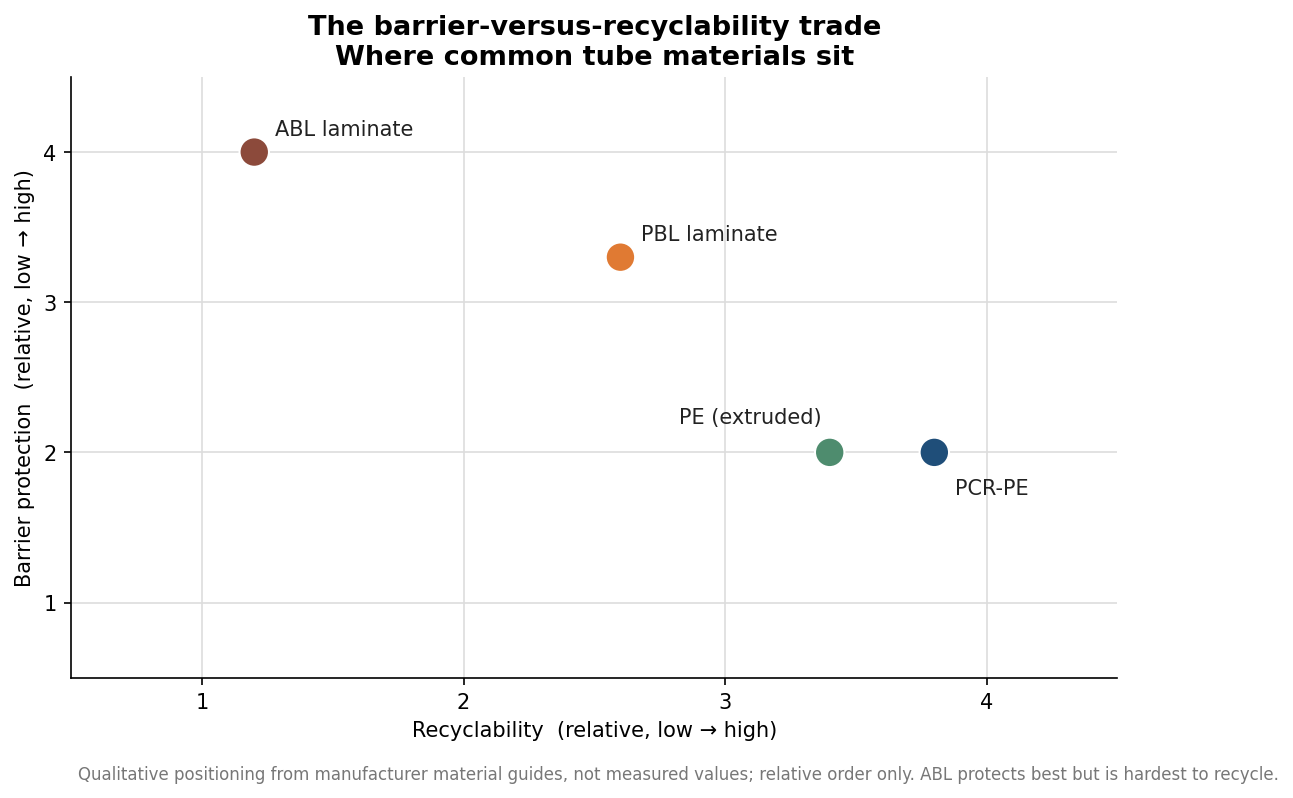
The takeaway is to match the material to how sensitive your formula is. A basic body lotion does not need ABL, and paying for it wastes money and recyclability. An oxidation-prone active with a two-year shelf life may genuinely need a laminate, and specifying plain PE there risks the product going off before it is used up. It also pays to think about the recycling claim you want to make on the carton, since a mono-material PE or PCR tube supports a cleaner recyclability story than a metal-plastic laminate, and mismatched claims invite scrutiny. Where a brand sits between these poles, PBL is often the compromise that keeps both the barrier and the sustainability message intact.
The nozzle and cap decide how it dispenses
The outlet is the part the customer actually interacts with every day, so match it to the product’s texture and dose. A fine nozzle tip suits serums and targeted treatments where a small, precise bead is the goal. A flip-top cap is the convenient everyday choice for creams and lotions used at volume, opening one-handed and reclosing fast. A screw cap seals more securely for products stored a long time or carried in a bag, and applicator or airless configurations serve premium or sensitive formulas where the tube doubles as the tool or needs to limit air exposure.
Orifice size interacts with viscosity in a way worth flagging to your supplier. A thick cream through a pinhole nozzle frustrates the user, while a thin lotion through a wide opening over-dispenses and wastes product. This is one more reason the outlet, the diameter, the cap, and the wall thickness all get decided together rather than one at a time.
Wall thickness, decoration, and the order that follows
Wall thickness governs the squeeze feel and a little of the protection. Extruded PE tubes typically run about 0.4 to 0.6 mm for LDPE and 0.45 to 0.65 mm for HDPE, with thinner walls feeling softer and thicker walls feeling more substantial and premium. Because the tube surface is your primary branding real estate, decide decoration alongside the material, since laminates and PE take print differently and finishes like matte, gloss, and metallic effects depend on the base structure.
Put together, a sensible spec reads as a short chain of linked choices: fill volume sets the diameter and length, formula sensitivity sets the material, texture and dose set the nozzle and cap, and usage feel sets the wall thickness. Bring all of it to a supplier at once, ideally with a sample of the real formula, and ask for a filled sample before the full run. Tubes are inexpensive per unit at volume, but tooling and plates are not, so the cost of a wrong guess is paid at scale. The few extra questions up front are what keep a good formula from arriving in the wrong package.