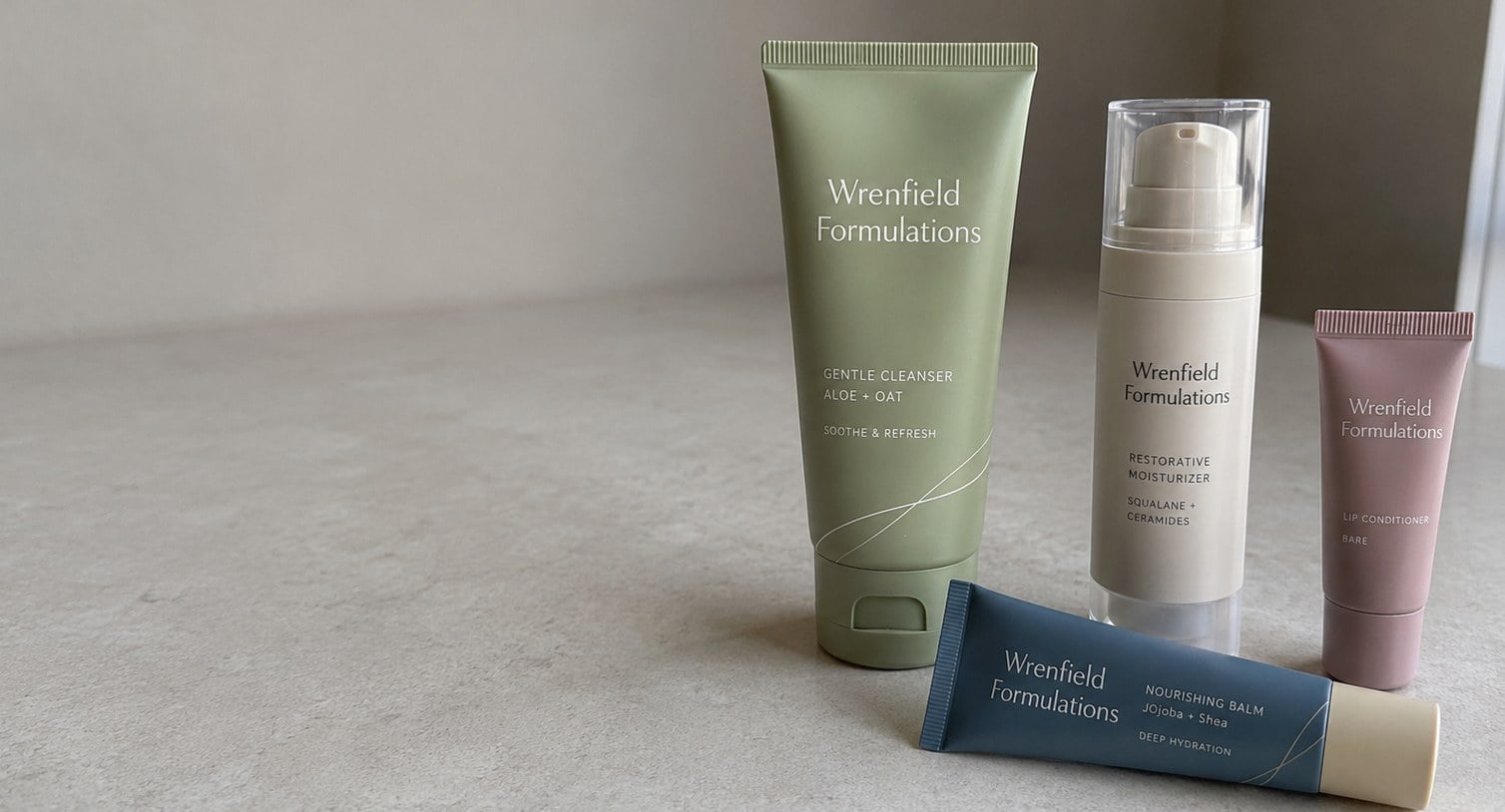
Artwork for custom cosmetic tubes should arrive as vector files with outlined fonts, sit inside the body panel clear of the shoulder and tail seal, and name brand colors as Pantone references. Custom Cosmetic Tubes turns those files into a free mockup within 24 hours, so you can check placement, color and every line of copy before approving production.
- Vector AI, EPS, SVG or PDF with outlined fonts prints cleanest.
- Artwork must stay clear of the shoulder and the tail crimp seal.
- Light inks on dark tubes may need a white underlay.
- Free mockup within 24 hours, unlimited free revisions, pay nothing until you approve.
- Minimum order 12; standard turnaround 2 to 4 weeks after approval.
What artwork files do you need for custom cosmetic tubes?
For custom cosmetic tubes, send vector artwork: an AI, EPS, SVG or vector PDF file with every font converted to outlines. Vector files keep logos and small regulatory text crisp when they are scaled onto a curved tube body, and they let the printer separate each spot color into its own screen or plate.
A high-resolution raster file can still work for a photographic or gradient design printed by offset, but a logo pulled from a website or social profile almost never prints cleanly. If vector files are all you have from an old agency, send them as they are. If you only have a JPG or PNG, send that too: the Custom Cosmetic Tubes art team will tell you in the free mockup whether it needs to be redrawn before production.
- Best: vector AI, EPS, SVG or PDF with outlined fonts and named spot colors.
- Workable: high-resolution raster art for full-color offset designs.
- Risky: screenshots, low-resolution web logos and artwork embedded inside a Word or slide file.
Where does the printable area sit on a cosmetic tube?
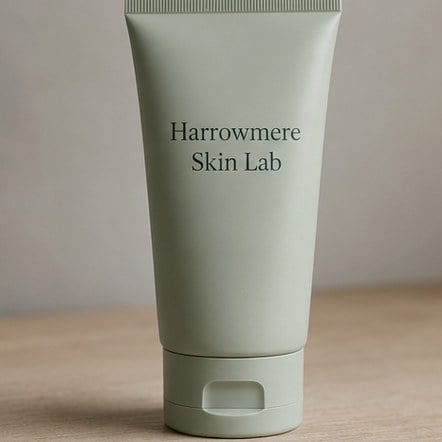
The printable area on a cosmetic tube is the flat-pressed body between the shoulder and the crimp seal at the tail. Artwork has to stop short of both ends: the shoulder curves away from the print head, and the tail is heat-sealed after filling, so anything placed too close to the open end gets crushed into the crimp or distorted by the seal.
Think of each tube as having a front panel and a back panel. The front carries the brand mark and product name; the back carries directions, the ingredient list, the net contents line and any barcode. On barrier laminate tubes there is also a side seam where the laminate sheet is joined, so text and fine lines should not cross it. Extruded mono-material PE tubes are seamless, which makes wraparound designs easier to run cleanly.
Caps and the shoulder are usually left undecorated or colored by material choice rather than print, so plan your brand moment on the body itself.
How should you lay out a front and back panel for printed cosmetic tubes?
Lay out printed cosmetic tubes with a clear hierarchy: one dominant logo or product name on the front, a short descriptor under it, and every required or instructional line grouped on the back. Tubes are narrow, so a layout that looks balanced on a flat jar label often feels crowded once it wraps the curve of a tube.
- Start from the template. Ask for the flat dieline for your exact tube size before you design. Custom Cosmetic Tubes supplies one with the safe zone, the seal area and any seam marked.
- Run text along the length. On slim tubes, vertical text along the body is often more legible than short horizontal lines.
- Reserve the back for compliance copy. Directions, ingredients, net contents and the distributor line all need room; leave it before adding decoration.
- Keep a quiet zone for codes. A barcode needs contrast and a flat area away from the seal and seam.
- Leave space for a batch code. Many fillers stamp a lot code into the crimp; keep artwork clear of that strip.
How do tube color and ink color interact on custom cosmetic tubes?
On custom cosmetic tubes, the tube material is part of the artwork. Ink sits on top of the tube body, so a light ink on a dark or colored tube may need a white base layer underneath it to look the way it does on screen. Without that underlay, a pale pink on a black tube can print muted or slightly transparent.
Specify brand colors as Pantone spot references rather than screen colors whenever you can, and tell the art team whether the tube body is white, natural, colored or metallic. A natural (translucent) tube shows the product through the wall, which changes how every printed color reads once the tube is filled.
| Tube body | What to plan for |
|---|---|
| White | Truest color match; the easiest base for multi-color logos. |
| Colored or black | Light inks may need a white underlay; metallic foil reads strongly. |
| Natural or clear | Fill color shows through; test contrast against the formula itself. |
| Metallic or pearl | Fine type can lose contrast; bold marks and dark inks hold up best. |
How does the decoration method change your artwork for cosmetic tubes?
Each decoration method on cosmetic tubes has its own artwork rules, so build the file for the method you plan to use. Silkscreen prints one spot color per pass and favors solid shapes; offset handles gradients and photographic designs; hot stamping lays down foil and dislikes hairline detail; a pressure-sensitive label is designed like a flat label with its own edge margins.
- Silkscreen: separate each color as its own layer, avoid fine halftones and keep thin strokes bold enough to hold ink.
- Offset: supply full-color art with gradients flattened correctly; small reversed text needs extra weight.
- Hot stamp foil: supply the foil area as a single solid shape; very fine serifs and tiny type can fill in.
- Labels: design to the label size, not the tube size, and keep text away from the label edge.
If you are still choosing a method, the existing comparison on this blog walks through the trade-offs; this guide focuses on getting the file right once the method is chosen. Most custom squeeze tubes combine one method on the front and simple one-color print on the back.
What small text and regulatory copy belongs on a cosmetic tube?
Small text on a cosmetic tube usually includes the ingredient list, directions, warnings, net contents and the name and location of the brand or distributor. Your brand owns the wording and the compliance of that copy; the printer reproduces what you approve. Get the text finalized and checked before artwork goes to proof, because a late ingredient change means a new proof.
Keep regulatory text in a plain, open typeface with generous letter spacing. Condensed and light-weight fonts look elegant on a mood board but tend to fill in on a curved, squeezable surface. Avoid reversing tiny copy out of a dark background; dark text on a light panel is far more forgiving.
When one design runs across several sizes, check the smallest tube first. A back panel that fits comfortably on a large tube can become unreadable on sample and travel tubes, and those often need a shortened layout with the essential lines only.
How does the proof and approval process work for custom cosmetic tubes?
For custom cosmetic tubes, the proof is where artwork problems get caught for free. Custom Cosmetic Tubes returns a free digital mockup within 24 hours of receiving your artwork, showing the design on the tube body with the colors, method and placement called out. You can request unlimited free revisions, and you pay nothing until you approve the design.
Read the proof as a checklist, not a picture:
- Check every word of copy, especially the ingredient list and net contents.
- Confirm each Pantone reference and the tube body color.
- Look at what sits near the seal, the shoulder and any seam.
- Confirm the cap style and color shown matches what you want.
- Confirm the quantity, at least the minimum of 12, and the decoration method.
Once you approve, production starts and standard turnaround is 2 to 4 weeks, with faster delivery available through express shipping. The how it works page shows each step from quote to delivery.
What artwork mistakes cause the most reprints on cosmetic tubes?
Most reprints on cosmetic tubes trace back to a handful of avoidable artwork mistakes: text placed in the seal area, live fonts that substitute, screen colors that print differently, and copy that was changed after the proof was approved. Each one is cheap to fix at mockup stage and expensive to fix after a run is filled.
- Artwork in the crimp: logos placed too close to the tail get flattened when the tube is sealed after filling.
- Fonts not outlined: a missing font swaps in a default typeface and shifts every line.
- RGB brand colors: on-screen colors rarely match printed ink; name a spot color instead.
- Ignoring the fill: on natural tubes, a dark formula can swallow dark ink.
- One layout for every size: a design scaled down to a small tube shrinks regulatory text below legibility.
- Approving from a phone: review the proof full-size so small errors are visible.
Send your files, or simply your logo and a short note, through the custom quote form and the art team will flag any of these before you approve.
Frequently asked questions
Can I send a Canva design for custom cosmetic tubes?
Custom cosmetic tubes can be printed from a Canva design as long as it is exported as a print-quality PDF with fonts embedded or outlined. Canva files often use screen colors, so the art team at Custom Cosmetic Tubes will convert them to spot ink references and show the result in the free mockup, which arrives within 24 hours, before you approve anything.
Should fonts be converted to outlines before sending cosmetic tube artwork?
Cosmetic tube artwork should have every font converted to outlines or embedded in a vector PDF. If a font is missing on the printer's system, another typeface is substituted and line breaks shift, which can push copy into the seal area. Outlining locks the shapes so the printed tube matches the layout you approved on the proof.
How do I match my exact brand color on printed cosmetic tubes?
Printed cosmetic tubes match brand colors most reliably when you specify a Pantone spot reference rather than an RGB or hex value from your website. Tell the art team the tube body color too, because a white tube, a colored tube and a natural translucent tube each change how the same ink appears once the product is filled.
Do light inks need a white base on dark cosmetic tubes?
Light inks on dark or colored cosmetic tubes often need a white underlay printed first so the color looks bright and opaque. Without it, pastel and white-adjacent shades can look muted against the tube body. The free mockup from Custom Cosmetic Tubes notes when an underlay is recommended for your design and tube color.
Can one artwork file work across several cosmetic tube sizes?
One artwork file can be adapted across several cosmetic tube sizes, but each size needs its own layout check. Front logos usually scale well, while back panels with ingredients and directions may become too small on a slim tube. Ask for a dieline per size and approve a separate proof for each tube in the range.
Can text wrap all the way around a cosmetic tube?
Wraparound text works best on seamless extruded cosmetic tubes, such as mono-material PE, because there is no side seam to break the design. Laminate tubes have a joining seam where fine lines and type should not cross. Your proof will show where the seam falls so you can position wraparound elements to avoid it.
Where should a barcode go on custom cosmetic tubes?
A barcode on custom cosmetic tubes belongs on a flat stretch of the back panel, away from the shoulder curve, the tail seal and any side seam. Print it in dark ink on a light background with a clear margin around it, and run the bars along the tube's length so the curve does not distort the scan.
Who checks the ingredient list on printed cosmetic tubes?
The brand owns the ingredient list and compliance wording on printed cosmetic tubes. Custom Cosmetic Tubes reproduces the copy exactly as you approve it, so have the text reviewed by whoever handles your formula and labeling before the proof stage. Changing wording after approval means a new proof and can delay the 2 to 4 week production schedule.
What happens if I spot an error after approving cosmetic tube artwork?
Cosmetic tube artwork errors found after approval should be reported immediately, because production starts once the proof is signed off. If printing has not begun, a corrected proof can often replace the old one. Reading every line of the free mockup, at full size rather than on a phone, is the best protection against a costly reprint.
Can hot stamp foil reproduce fine detail on cosmetic tubes?
Hot stamp foil on cosmetic tubes works best with bold, solid shapes such as a logo mark or wordmark. Hairline strokes, tiny serifs and small regulatory text tend to fill in or break up, so keep foil for the hero element and print the fine copy in ink. Supply the foil area as a single solid vector shape.
Do I need a designer before ordering custom cosmetic tubes?
Custom cosmetic tubes can be ordered without hiring a designer if you already have a clean logo and finalized product copy. The art team places your elements on the dieline, suggests colors that suit the tube body and returns a free mockup within 24 hours, with unlimited free revisions until the layout is right and nothing to pay before approval.
Get a free mockup for your cosmetic tubes
Send your logo or idea and the quantity you have in mind. Custom Cosmetic Tubes returns a free mockup within 24 hours, you approve the design before anything is produced, and standard turnaround is 2 to 4 weeks with faster options available. Get a custom quote.